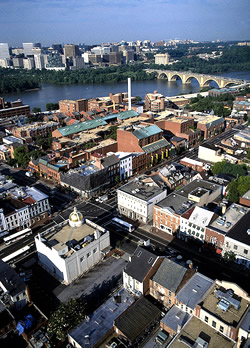
 per Gotham Gazette
"...[T]he Obama platform explicitly states that cities should be seen not as the problem but as the solution. But he means the metropolitan regions, not the central cities. With this in mind, his specific solutions include: creation of a National Infrastructure Reinvestment Bank funded to the tune of $10 billion over 10 years; regional clusters for economic innovation; business incubators; workforce training; and green technology and green jobs.
Obama's platform still offers something for the older central cities. In housing and community development, areas of considerable concern to central cities like New York, Obama would restore rent subsidies and public housing operating funds that were cut under the George W. Bush administration - actions that might help the
New York City Housing Authority balance its budget and prevent privatization. He would restore and increase Community Development Block Grant funding and create 20 "Promise Neighborhoods" that comprehensively deal with poverty. The Obama platform supports homeland security and community policing but requires police to be attentive to issues of accountability and brutality. Broader economic policies such as increasing the minimum wage and Earned Income Tax Credit are also listed as part of Obama's urban policy.
Obama addresses the "livability of cities"-- particularly public health and environmental concerns -- by calling for efforts to combat inefficient low-density suburban sprawl through "smart growth" around higher density urban centers. Smart growth has been a major goal of urban planning professionals in the nation.
"Our communities will better serve all of their residents," says the Obama campaign, "if we are able to leave our cars, to walk, bicycle and access other transportation alternatives." This could lead to federal support for recent efforts by the New York City Department of Transportation to improve the bicycle and pedestrian infrastructure. In the Senate, Obama sponsored the
Healthy Places Act requiring federal agencies to evaluate the health impacts of urban policies."
I've posted Obama's policy stances because not only is his candidacy the one I am most interested in but also, his proposals and viewpoints on urban policy are much more aligned to what I believe is how a city should be handled. His proposals (or policy positions) are progressive, intelligent, and empathetic. Predictably, McCain offers more of the same program-slashing and budget-cutting of generic Republican ideology. There is no doubt that under a McCain administration cities and their inhabitants, particularly low income residents, would be slapped in the face and forgotten, much like the record of the Bush administration and any Republican administration since the inception of the Great Society programs under Democratic President Lyndon B. Johnson.


No comments:
Post a Comment